

Medical Education Day Explores Future of Learning
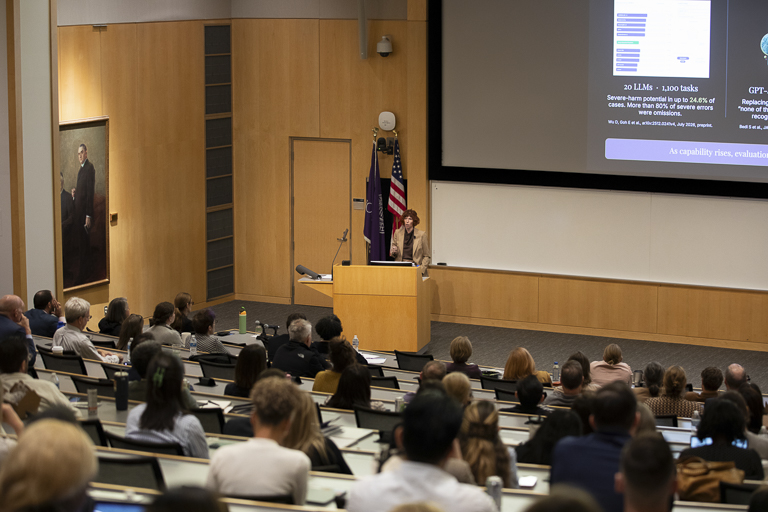
Faculty, trainees, students and staff gathered on September 23 for the 16th Annual Medical Education Day, a yearly celebration of teaching excellence, educational innovation and scholarship across the Feinberg community. The event featured presentations, workshops, panel discussions, poster sessions and a keynote lecture focused on one of the most transformative forces shaping healthcare education today: artificial intelligence.
Hosted by the Feinberg Academy of Medical Educators (FAME), Medical Education Day showcased innovative approaches to teaching and learning while providing attendees with opportunities to share research, exchange ideas and explore emerging trends in health professions education. The day opened with workshops and panel discussions examining topics ranging from graduate medical education funding and healthcare worker burnout to implicit bias in clinical communication.
“This year’s medical education day is heavily focused on artificial intelligence, and I think that as we very rapidly embark into this new world, this gives educators a nice foundation from which to direct their curricula and build their own personal knowledge as well as their students,” said Mary McBride, MD, MEd, professor of Pediatrics and of Medical Education and director of the Feinberg Academy of Medical Educators.
During the keynote lecture, Laurah B. Turner, PhD, associate dean for artificial intelligence and educational informatics at the University of Cincinnati College of Medicine, discussed the opportunities and challenges of using AI in medical education. Her presentation explored ethical and technical considerations, as well as practical frameworks for evaluating the use of AI tools in medical education.
“What does good practice look like with these AI tools? This is evolving. The behaviors are shifting. The technologies continue to emerge,” Turner said. “Medical practice with AI doesn’t look the same as practice without it, and it’s not going to look the same in six months from now. So, how do we solve for that paradox?”
While data on the cognitive impacts of AI use are still sparse, Turner cited early studies that showed a loss of skills after consistent use of AI tools. Whether AI helps or hinders human judgment, Turner said the difference may lie in how it is used.
“When AI is employed as a substitute for cognitive effort, we see de-skilling,” Turner said. “However, when AI is deployed in such a way that it is a scaffold and it demands human cognitive effort in collaboration with an AI, you see up-skilling. The direction of the effect comes from the workflow itself.”
Earlier in the day, attendees participated in a hands-on workshop led by Rachel Goc, PhD, and Bea Jimenez, MS, who are both learning engineers with Northwestern Information Technology. The session introduced medical educators to effective prompting techniques, methods for evaluating AI-generated outputs and strategies for developing AI literacy among students. Presenters also shared research insights into the impact of generative AI on learning and teaching.
“What we hope we bring to you today is the recasting of what you already know about AI within a learning context,” Goc said. “And to think about what it means for teaching and what it means for your students.”
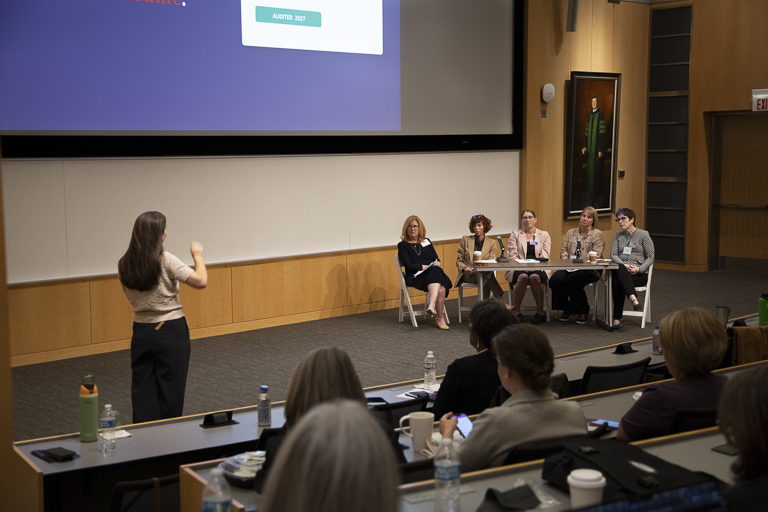
Attendees also competed for a chance at $10,000 in funding during a competition in the style of “Shark Tank,” where faculty pitched new ideas at the intersection of medical education and artificial intelligence. The rapid-fire presentations showcased how Feinberg faculty and trainees are exploring innovative ways to leverage new technologies to support teaching, learning and professional development while addressing real-world educational challenges.
The winning project was led by Emily Hinchcliff, MD, MPH, assistant professor of Obstetrics and Gynecology in the Division of Gynecologic Oncology, and David Liebovitz, MD, professor of Medicine in the Division of General Internal Medicine. Their pitch outlined the creation of an AI auditor to ensure the medical education curriculum stays up to date and comprehensive with the latest research and technological innovations.
Additional sessions throughout the day examined the role of AI in curriculum development, clinical supervision and learner assessment, reflecting the growing emphasis placed on emerging technologies in medical education. Other workshops explored innovations in bedside medicine, faculty development, mentorship, leadership and wellness.
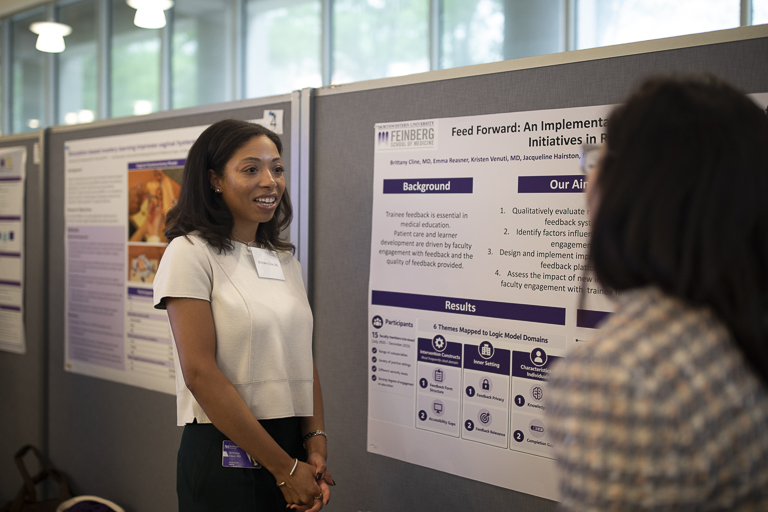
The event also included research poster presentations highlighting ongoing work from faculty, trainees and students across Feinberg,
The day concluded with an awards ceremony recognizing faculty members for outstanding contributions to health professions education.
Legal Disclaimer:
EIN Presswire provides this news content "as is" without warranty of any kind. We do not accept any responsibility or liability for the accuracy, content, images, videos, licenses, completeness, legality, or reliability of the information contained in this article. If you have any complaints or copyright issues related to this article, kindly contact the author above.
