

Multiple Sclerosis Therapeutics Market Growth Accelerates with Biologics & Precision Medicine| DataM Intelligence
Multiple Sclerosis Therapeutics Market
Driven by new biologics and personalized Multiple Sclerosis treatments, the global therapeutics market is forecast to reach USD 46.22B by 2033.
The future of Multiple Sclerosis therapy lies in targeted immunology, regenerative strategies, and patient-centric treatment pathways supported by AI-driven diagnostics.”
AUSTIN, TX, UNITED STATES, December 2, 2025 /EINPresswire.com/ -- According to DataM Intelligence, the multiple sclerosis therapeutics market size reached US$ 27.42 Billion in 2024, rising from US$ 25.98 Billion in 2023. The market is projected to reach US$ 46.22 Billion by 2033, growing at a CAGR of 6.1% during 2025–2033. This growth is supported by continuous innovation in disease-modifying therapies (DMTs), increasing adoption of high-efficacy biologics, and improved patient management protocols.— DataM Intelligence
The Multiple Sclerosis (MS) Therapeutics Market is evolving rapidly as advancements in immunology, monoclonal antibody development, and personalized treatment strategies reshape patient care. The growing burden of MS across key regions, combined with expanding access to advanced neurological treatment, continues to fuel strong industry growth.
The market is dominated by disease-modifying therapies, which remain the preferred option to slow disease progression, limit relapses, and preserve long-term neurological function. North America continues to hold the largest market share due to a well-developed healthcare infrastructure, strong reimbursement programs, and early adoption of innovative MS treatments such as monoclonal antibodies and next-generation oral agents. Meanwhile, Europe and Asia-Pacific show accelerating growth, supported by improving diagnostic capabilities and growing healthcare access.
Get a Sample PDF Of This Report (Get Higher Priority for Corporate Email ID):– https://www.datamintelligence.com/download-sample/multiple-sclerosis-therapeutics-market
Key Highlights from the Report
➤ Global market size reached US$ 27.42 Billion in 2024, with expectations to hit US$ 46.22 Billion by 2033.
➤ Disease-modifying therapies remain the largest and fastest-expanding product category.
➤ North America leads the global market due to high treatment affordability and strong neurology networks.
➤ Next-generation monoclonal antibodies and oral MS treatments are gaining rapid adoption.
➤ Rising MS prevalence and improved MRI-based diagnostics are expanding the treatment pool.
➤ Strategic alliances and R&D investments are accelerating innovation in progressive MS therapeutics.
Recent Developments:
1. Newly Approved & Updated Therapies
Ocrevus Zunovo (Ocrelizumab & Hyaluronidase): Approved by the FDA in September 2024, this is a subcutaneous (under the skin) injection version of the popular infusion Ocrevus. It cuts administration time from hours to just 10 minutes twice a year, significantly improving patient convenience while maintaining the same efficacy.
Tyruko (Natalizumab-sztn): A biosimilar to Tysabri, now available to provide a more affordable high-efficacy option for relapsing forms of MS.
2. Late-Stage Clinical Trial Breakthroughs
These therapies are in Phase 3 trials and are the closest to potential FDA approval.
BTK Inhibitors (The "Brain-Penetrant" Class)
Bruton's Tyrosine Kinase (BTK) inhibitors are small molecules designed to cross the blood-brain barrier to target inflammation inside the brain, something current antibodies struggle to do well.
Fenebrutinib (Roche): In late 2025, Phase 3 results showed it significantly reduced relapses in Relapsing MS (RMS) and, crucially, slowed disability progression in Primary Progressive MS (PPMS). This is a major win, as few treatments work for PPMS.
Tolebrutinib (Sanofi): Results have been mixed. While it faced regulatory delays for relapsing forms due to liver safety concerns, it has shown promise in delaying disability accumulation in non-relapsing Secondary Progressive MS (nrSPMS), a group with very few options.
Frexalimab (Anti-CD40L)
Mechanism: A novel second-generation antibody that blocks the CD40-CD40L costimulatory pathway, effectively preventing T-cells and B-cells from "talking" to each other and activating the immune attack.
Status: After strong Phase 2 results showing an 89% reduction in lesions, it is now recruiting for massive global Phase 3 trials (FREXALT for RMS and FREVIVA for SPMS).
3. Emerging & Novel Approaches (Phase 1/2)
"Inverse Vaccines" (Immune Tolerance)
Unlike traditional vaccines that teach the immune system to attack, these "inverse vaccines" teach the immune system to ignore specific targets (like myelin), effectively stopping the autoimmune attack without suppressing the entire immune system.
Key Player: Anokion's KAN-101 has shown early success in teaching the liver to recognize myelin proteins as "safe," potentially offering a cure-like "immune reset."
CAR-T Cell Therapy
Borrowed from cancer treatment, this involves taking a patient's T-cells, engineering them to hunt down B-cells (CD19+), and infusing them back.
Status: Early trials (including at UCL and Columbia University) are testing this as a "one-and-done" immune reset for patients who don't respond to other drugs. Early data suggests it can deeply deplete B-cells in the brain.
Remyelination (Repairing the Damage)
Therapies that aim to regrow myelin rather than just stop attacks.
PIPE-307: A drug targeting the M1 receptor entered Phase 2 trials. It works by "unlocking" the brain's ability to produce new myelin-making cells.
ESI1: A preclinical breakthrough discovered in 2024 that mimics the "softness" of young brain tissue to encourage older oligodendrocyte cells to repair myelin sheaths.
4. Epstein-Barr Virus (EBV) Targeting
Following the landmark confirmation that EBV is the leading cause of MS, trials are now targeting the virus directly.
EBV Vaccines: Moderna has initiated the "Horizon" trial (Phase 2) in the UK and globally, testing an mRNA vaccine (mRNA-1195) in patients already diagnosed with MS to see if suppressing the virus stops disease progression.
Antivirals: The FIRMS-EBV trial is testing if established antivirals (like tenofovir) can reduce fatigue and disease activity by suppressing viral reactivation.
5. Biomarkers & Diagnosis (2025 Updates)
McDonald Criteria 2025: A major update to the diagnostic criteria is rolling out. It incorporates new MRI markers like the Central Vein Sign (CVS) and Paramagnetic Rim Lesions (PRL) to allow for earlier and more accurate diagnosis, distinguishing MS from mimics like migraines or small vessel disease.
Blood Tests (Liquid Biopsy):
NfL (Neurofilament Light Chain): Moving closer to standard clinical use to predict relapses before they happen.
Octave Bioscience: Received new funding in late 2025 to develop a "Disease Progression" blood test that uses AI to measure subtle worsening that MRI scans might miss.
Company Insights:
• Biogen Inc.
• Novartis AG
• Merck KGaA
• Sanofi
• Roche Holding AG
• Bristol-Myers Squibb
• Teva Pharmaceutical Industries Ltd.
• Pfizer Inc.
• Bayer AG
• GlaxoSmithKline (GSK)
Request for Customized Sample Report as per Your Business Requirement: https://www.datamintelligence.com/customize/multiple-sclerosis-therapeutics-market
Market Segmentation:
The Multiple Sclerosis Therapeutics Market is segmented based on drug class, route of administration, disease type, and end-user, enabling a comprehensive understanding of therapeutic demand across different patient groups.
By drug class, disease-modifying therapies (DMTs) take the lead. This category includes interferon-beta products, S1P receptor modulators, fumarates, monoclonal antibodies, and emerging gene-targeted therapies. These drugs are widely recognized for delaying disability progression and reducing inflammatory disease activity. Symptomatic therapies including muscle relaxants, mobility aids, and pain management drugs form an essential complementary segment that enhances daily functioning and quality of life.
Oral drugs have significantly changed MS treatment preferences, offering greater convenience and improved compliance compared to injectables. S1P modulators and fumarate-based therapies are key contributors in this category. Injectables and infusion-based biologics remain crucial, especially for aggressive or progressive MS where high-efficacy drugs such as anti-CD20 monoclonal antibodies demonstrate strong clinical outcomes.
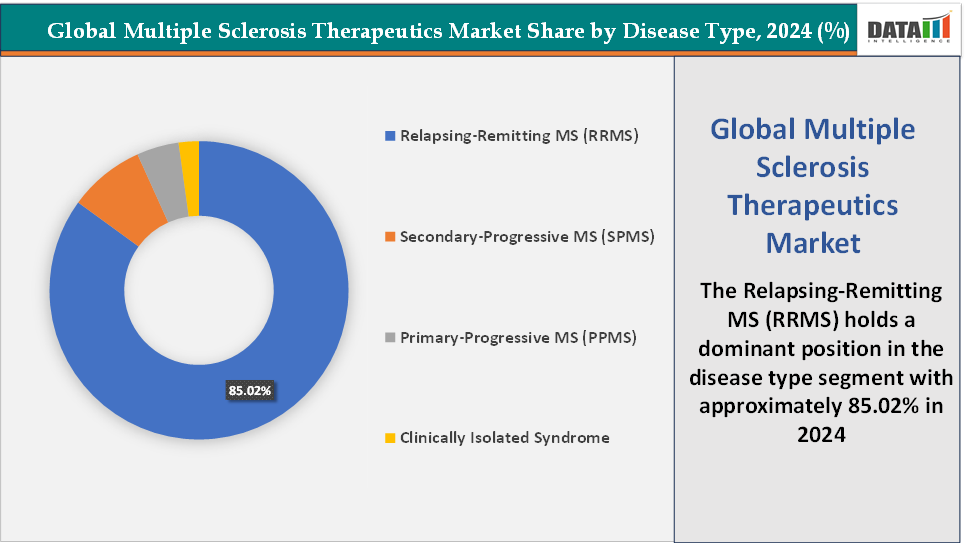
When assessed by disease type, Relapsing-Remitting MS (RRMS) is the most prevalent and thus represents the largest treatment segment. Secondary Progressive MS (SPMS) and Primary Progressive MS (PPMS) create increasing demand for advanced biologics and targeted therapies.
End-user segmentation is dominated by hospitals and specialized neurology centers, which provide comprehensive diagnostic, infusion, and long-term disease management services. Specialty clinics, followed by homecare settings for oral therapies, continue to gain significance.
Market Dynamics:
Market Drivers
Several powerful forces are driving sustained growth in the multiple sclerosis therapeutics market. The rising global prevalence of MS due to improved detection rates, lifestyle changes, and increased disease awareness has expanded the pool of patients requiring long-term therapy. Continuous innovation in DMTs, especially the development of monoclonal antibodies and targeted oral agents, has strengthened treatment effectiveness and prolonged relapse-free periods. Expanding clinical research pipelines and accelerated regulatory approvals across major markets further support long-term expansion. Additionally, digital health tools, remote neurological monitoring, and AI-based imaging tools are creating new opportunities for disease tracking and personalized treatment.
Market Restraints
The market faces several constraints despite strong growth potential. The high cost of branded MS therapies remains a major barrier, particularly in low- and middle-income countries, where affordability challenges restrict access to treatment. Safety concerns associated with long-term immunosuppressive therapy including increased infection risk, hepatotoxicity, and cardiovascular events remain significant considerations for clinicians and patients. Furthermore, the complex nature of MS diagnosis and limited access to neurologists in developing regions slow treatment initiation.
Market Opportunities
The future of the MS therapeutics market holds substantial opportunity. The development of biosimilars is expected to improve affordability and increase global treatment access. Advancements in precision medicine and biomarkers are paving the way for highly personalized treatment plans tailored to disease progression and patient genetics. The growing focus on remyelination therapies, neuroprotective agents, and regenerative medicine represents a breakthrough opportunity that could transform MS management over the next decade. Partnerships between pharmaceutical companies and research institutions continue to create fertile grounds for the next generation of MS therapeutics.
Buy This Report with Year-End Offer (Buy 1 report: Get 30% OFF | Buy 2 reports: Get 50% OFF each! Limited time offer): https://www.datamintelligence.com/buy-now-page?report=multiple-sclerosis-therapeutics-market
Regional Insights:
The global market reveals distinct regional trends shaped by healthcare capabilities, treatment affordability, and patient awareness levels.
North America
North America remains the dominant region, driven by the presence of major pharmaceutical players, high adoption rates of premium biologics, and widespread availability of advanced MRI technologies for early diagnosis. The United States, in particular, accounts for the majority of the regional revenue, supported by robust insurance coverage and strong MS advocacy networks.
Europe
Europe represents the second-largest market, bolstered by government-funded healthcare systems, high MS prevalence in Northern and Western Europe, and extensive clinical trial activities. Countries such as Germany, France, and the UK are leaders in the adoption of both branded and biosimilar MS therapies. The rising demand for cost-effective biologics is expected to boost regional growth further.
Asia-Pacific
The Asia-Pacific region is emerging as a high-growth market. Increasing awareness, improving healthcare infrastructure, and rising expenditure on chronic neurological diseases are contributing to rapid market expansion. Japan, China, and South Korea represent key contributors, with India showing increasing uptake of affordable oral MS drugs and biosimilars.
Latin America, Middle East & Africa
These regions show steady but gradual growth. Limited access to neurologists, lower diagnostic rates, and treatment affordability challenges hinder rapid expansion. However, improving healthcare reforms, increased clinical collaborations, and growing investments in specialty care are driving incremental progress.
Conclusion:
The Multiple Sclerosis Therapeutics Market is poised for significant expansion as innovation accelerates across disease-modifying therapies, advanced biologics, and personalized medicine. With the market projected to reach US$ 46.22 Billion by 2033, the next decade promises substantial progress in managing MS more effectively and enhancing patient quality of life. As treatment options become more targeted, accessible, and technologically supported, the future of MS therapy will be marked by greater precision, reduced disability progression, and expanded global access.
Related Reports:
Atherosclerosis Drugs Market
Therapeutic Apheresis Market
Sai Kiran
DataM Intelligence 4Market Research
+1 877-441-4866
email us here
Visit us on social media:
LinkedIn
X
Legal Disclaimer:
EIN Presswire provides this news content "as is" without warranty of any kind. We do not accept any responsibility or liability for the accuracy, content, images, videos, licenses, completeness, legality, or reliability of the information contained in this article. If you have any complaints or copyright issues related to this article, kindly contact the author above.
